
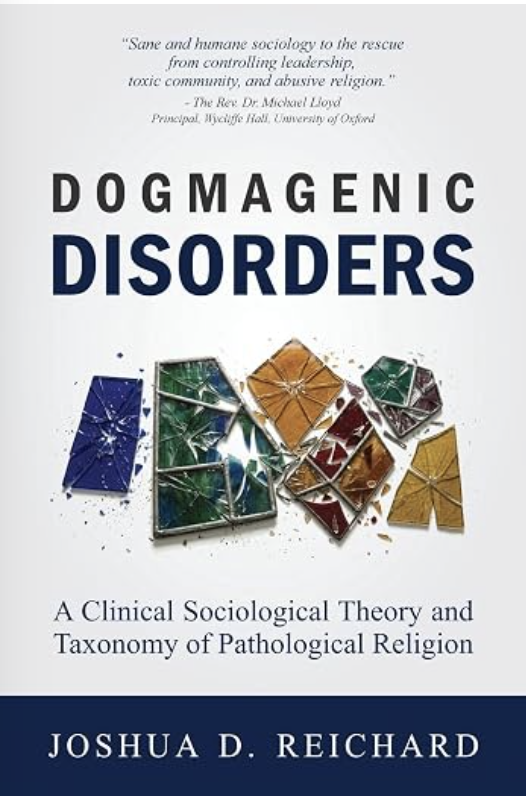
Description
Dogmagenic Disorders is a theoretical and clinically-driven framework for identifying, describing, and addressing religious dysfunction when dogma drives group-level harm. Rather than critiquing theology, it focuses on how belief is socially constructed, stabilized, and enforced, and the predictable consequences occurring when a group’s “Sacred Canopy” hardens into a rigid system that undermines human agency, empathy, and adaptation. Systemic social dysfunctions stall a group’s “social metabolism” (its capacity to process experience, feedback, and pluralism), producing real downstream harms for individuals, institutions, and public life.
Theoretical & Clinical Field Guide
The Sacred Canopy (nomos) – Explains how communities construct shelter from chaos (anomie), and how it becomes pathological through alienation, reification, and “Bad Faith.”
The Thomas Theorem – Treats each disorder as a “Definition of the Situation” that, once socially defined as real, produces real consequences.
Clinical Intervention – Translates theory into practical pathways aimed at restoring agency and rebuilding a breathable, ethically grounded Sacred Canopy (“Good Faith”).
Organized into four diagnostic clusters (Externalization, Objectivation, Internalization, and Terminal Systemic States), the eighteen distinct disorders range from Instrumentalized Sanctity Disorder (where a group is hijacked to serve a partisan political agenda) to Epistemic Closure Disorder (an echo chamber impervious to correction). Each features a structured clinical format: sociological etiology, group diagnostic criteria, consequences, differential diagnoses, and intervention pathways.







Reviews
There are no reviews yet.